
Every Attack on Pride Reminds Us Why We Still Need It.

Pride can be criticised. But criticism is increasingly becoming something much uglier.
An article about Medway Pride caught my attention recently. Not simply because of what it said, but because it felt increasingly familiar.
Throughout Pride season, and particularly in the days following Pride events, I have noticed article after article, Facebook post after Facebook post and comment after comment picking apart Pride.
Some raise legitimate questions. Others are full of judgement and misinformation. And underneath far too many of them sits rhetoric about LGBTQ+ people that can only be described as vile.
There is an irony here that seems to escape those declaring that Pride has gone too far or is no longer necessary.
They are demonstrating precisely why Pride still exists.
Pride should not be immune from criticism
Let's get something out of the way.
Pride isn't above criticism.
If an event describes itself as family-friendly, then organisers have a responsibility to consider what is appropriate within that space. Safeguarding should be taken seriously.
And if somebody associated with a Pride organisation commits a criminal offence, that person should be investigated and, where appropriate, prosecuted. If an organisation has failed in its safeguarding responsibilities, that should be investigated too.
None of this should be controversial.
But something else increasingly happens.
Individual incidents are taken and used to make sweeping claims about Pride and LGBTQ+ people more generally.
Suddenly we are no longer discussing whether a particular outfit was appropriate at a particular event.
We are discussing whether Pride itself is appropriate.
We are no longer talking about the criminal behaviour of an individual.
An entire community is being asked to account for it.
And increasingly trans people are pulled into the argument, regardless of whether being trans has anything whatsoever to do with the issue being discussed.
That isn't safeguarding.
It is something very different.
We've heard some of this before
For those of us old enough to remember previous battles for LGBTQ+ equality, some of this rhetoric feels horribly familiar.
There was a time when gay men and lesbians were routinely portrayed as a threat to children.
We were told that simply talking positively about homosexuality might somehow influence or recruit children.
In Britain, that thinking ultimately found expression in Section 28, which prohibited local authorities from intentionally promoting homosexuality and referred to teaching about the “acceptability of homosexuality as a pretended family relationship”.
Those attitudes caused enormous harm.
So when I see safeguarding language being stretched beyond legitimate concerns about specific behaviour and used to cast suspicion on LGBTQ+ people collectively, alarm bells ring.
Safeguarding children matters enormously.
But we can safeguard children without demonising LGBTQ+ people.
Those two things are not mutually exclusive.
Even the flag becomes controversial
One particularly strange aspect of the criticism surrounding Pride is the hostility towards the Progress Pride flag.
It is sometimes portrayed as though its existence represents some radical transformation of what Pride means.
But look at what the flag actually represents.
The Progress Pride flag incorporates the familiar rainbow alongside colours representing trans people and black and brown stripes recognising Black and Brown LGBTQ+ communities.
That matters.
LGBTQ+ history isn't solely white history. Black and Brown LGBTQ+ people have faced racism alongside homophobia, biphobia and transphobia — including, at times, racism from within LGBTQ+ communities themselves.
The Progress flag acknowledges that intersection.
It says our community is diverse and that people who have historically been pushed to its margins deserve to be visible too.
You don't have to like every redesign of a flag.
But treating a symbol designed to broaden inclusion as evidence that Pride has somehow lost its way completely misses its purpose.
Read the comments
Perhaps the clearest evidence of why Pride remains necessary isn't always found in the articles themselves.
It is found underneath them.
Look at the comments following almost any positive story about Pride or LGBTQ+ visibility.
There are legitimate disagreements and thoughtful criticism.
But alongside them there is often naked homophobia, transphobia, ridicule and contempt.
People complain that LGBTQ+ people are “shoving it down our throats”.
They ask why we need Pride at all.
They tell us nobody cares what we do in our bedrooms.
And sometimes the language becomes considerably worse.
The contradiction is extraordinary.
People write hundreds of angry comments underneath a Pride story to explain that nobody cares about LGBTQ+ people's sexuality.
They demand that LGBTQ+ people stop making themselves visible, while simultaneously insisting that discrimination against LGBTQ+ people no longer exists.
You cannot have it both ways.
Pride was never just a party
Perhaps we've done ourselves a disservice by allowing Pride to become understood primarily as a parade, a festival or a weekend of entertainment.
Because Pride has a history.
LGBTQ+ people were criminalised.
We lost jobs.
We lost homes.
Our relationships weren't legally recognised.
Lesbians could lose custody of their children.
Gay and bisexual men lived under discriminatory criminal laws.
During the AIDS crisis, LGBTQ+ communities experienced extraordinary loss alongside stigma and political indifference.
Trans people have their own long history of exclusion and discrimination.
People fought back.
They marched.
They organised.
They protested.
They challenged laws and institutions.
And gradually things changed.
Today's Pride celebrations exist because yesterday's LGBTQ+ people refused to remain invisible.
Pride doesn't end when the flags come down
There is another lesson in the hostility that surrounds Pride.
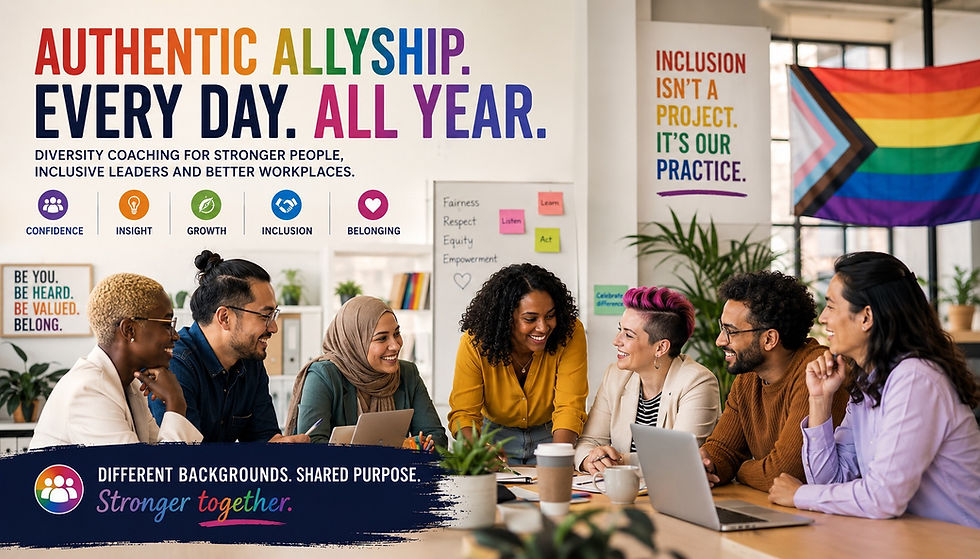
Allyship cannot be seasonal.
LGBTQ+ people don't only need allies during Pride month.
We need allyship 365 days of the year.
We need allies when the rainbow logos disappear from corporate social-media accounts.
We need allies when misinformation is circulated about LGBTQ+ communities.
We need allies when trans people are relentlessly turned into political talking points.
We need allies when someone makes a homophobic joke and assumes everyone else will laugh.
We need allies when an LGBTQ+ colleague is treated differently at work.
And increasingly, we need allies online.
Because one of the easiest things in the world is to scroll past hatred when it isn't directed at you.
Real allyship sometimes means being the person who says: No. That's not acceptable.
Pride can evolve without disappearing
None of this means Pride should resist criticism.
Quite the opposite.
Pride should constantly ask itself who it represents, who feels excluded, whether events are accessible, how commercialisation affects the movement, whether safeguarding is effective and whether younger and older LGBTQ+ people alike feel Pride still belongs to them.
Those are healthy conversations.
But they are fundamentally different from taking isolated incidents and using them to suggest there is something inherently troubling about LGBTQ+ visibility itself.
There is a difference between scrutiny and stigma.
There is a difference between safeguarding and stereotyping.
And there is a difference between criticising something that happened at Pride and condemning what Pride represents.
We should be capable of recognising those distinctions.
Because Pride isn't perfect.
It was never supposed to be.
It is a constantly evolving expression of an extraordinarily diverse community.
But every time LGBTQ+ people are told to be quieter, less visible or less proud, we are reminded of something important.
Every hostile article.
Every transphobic comment.
Every homophobic slur.
Every demand that we disappear quietly back into private life.
They all unintentionally answer the question:
Why do we still need Pride?
Because equality on paper does not automatically create equality in people's lives.
Because visibility still attracts hostility.
Because some LGBTQ+ people still grow up wondering whether the world will accept them.
And because rights gained by previous generations should never be taken for granted.
So yes, let's talk about how Pride can be better.
Let's talk about safeguarding.
Let's talk about inclusivity.
Let's talk about accessibility, commercialisation and who Pride is actually for.
But let's also recognise what is happening when criticism crosses the line into something else.
And let's remember that when the parade is finished, the stages have been dismantled and the rainbow flags have been packed away, LGBTQ+ people are still here.
Pride may happen once a year.
Our need for equality, visibility and allyship doesn't.
🏳️🌈🏳️⚧️


Comments